Role of Chromogenic FVIII Assays in Hemophilia A Diagnosis
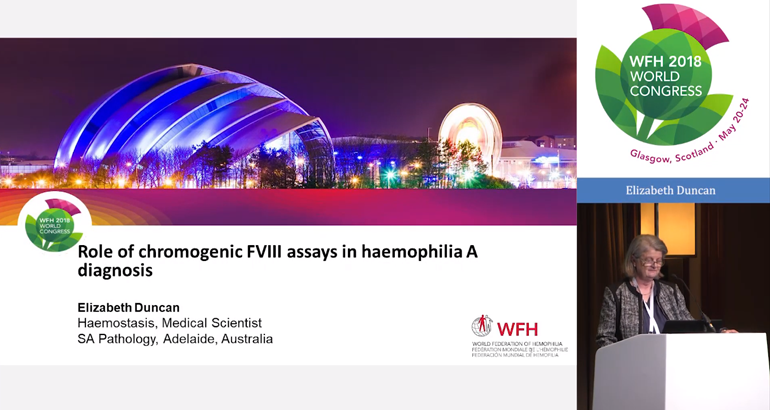
In the Tuesday afternoon session entitled Role of Chromogenic Assays in Hemophilia Diagnosis, Elizabeth Duncan presented a comparison of clotting

Year: 2012
Language: Traditional Chinese
Author(s): Street A, Brewer AK, Mauser-Bunschoten EP, Key NS, Kitchen S, Llinas A, Ludlam CA, Mahlangu JN, Mulder K, Poon MC, Srivastava A
Format: Document
The 3rd edition is available in: English, French, Spanish, Arabic, Russian
The 3rd edition has also been translated into the following languages, with permission from the WFH, by NMOs/Other Organizations: Georgian, Portuguese, Ukrainian
The 2nd edition is also available in: Simplified Chinese
The 2nd edition has also been translated into the following languages, with permission from the WFH, by NMOs: Azerbaijani, Polish
This is not an official WFH translation. This resource has been translated with permission by a WFH National Member Organization (NMO), and is shared here with their kind permission. Translating organizations are encouraged to have translations reviewed by local experts, the WFH is not responsible for the translation or for any errors or changes to content from the original English edition. Patient organizations interested in translating a WFH resource must first obtain permission from the WFH, available here.
Hemophilia is a rare disorder that is complex to diagnose and manage. By compiling the second edition of its Guidelines for the Management of Hemophilia, the World Federation of Hemophilia (WFH) aims to provide practical, evidence-based guidance to healthcare providers, government authorities, and patient organizations seeking to initiate and/or maintain hemophilia care programs. It is also hoped these guidelines will encourage practice harmonization around the world and, where recommendations lack adequate evidence, stimulate appropriate studies. For additional resources related to the WFH Guidelines for the management of hemophilia, visit the English resource page.

In the Tuesday afternoon session entitled Role of Chromogenic Assays in Hemophilia Diagnosis, Elizabeth Duncan presented a comparison of clotting

The purpose of this guide is to inform and facilitate the selection and purchase of therapeutic products for the treatment

Adapted from: Global NMO Training 2016 plenary presentation by Glenn PierceReviewed by: Glenn PierceEdited by: Georghia Michael This first eLearning

Using the universal language of pictures, children around the world can learn about hemophilia in a fun, easy to understand,
Volunteer team members, and their beneficiaries, often have differing opinions on what projects should be of highest priority for an

This step-by-step video clearly demonstrates the correct technique for the execution of the manual assay for the presence FVIII inhibitors.