
General Care and Management of Hemophilia
This eLearning module presents Section 1 of the WFH Guidelines for the Management of Hemophilia: General Care and Management of

Year: 2020
Language: English
Author(s): World Federation of Hemophilia
Format: Video
In this session from the WFH 2020 Virtual Summit, Glenn Pierce, Alok Srivastava, Steven Pipe, Manuel Carcao, Margaret Ragni and Johnny Mahlangu present and discuss updates to the WFH Guidelines for the Management of Hemophilia.
Discussion topics include hemostatic agents, prophylaxis, inhibitors, and treatment of specific hemorrhages.
Click below to access more on-demand Virtual Summit recordings.
The WFH does not engage in the practice of medicine and under no circumstances recommends particular treatment for specific individuals. For diagnosis or consultation on a specific medical problem, the WFH recommends that you contact your physician or local treatment centre. Before administering any products, the WFH urges patients to check dosages with a physician or hemophilia centre staff, and to consult the pharmaceutical company’s printed instructions.
The WFH does not promote any particular pharmaceutical product and any mention of any commercial brand in this presentation is strictly for educational purposes.

This eLearning module presents Section 1 of the WFH Guidelines for the Management of Hemophilia: General Care and Management of

This eLearning module presents Section 5 of the WFH Guidelines for the Management of Hemophilia: Treatment of Specific Hemorrhages. Detailed

This eLearning module presents Section 3 of the WFH Guidelines for the Management of Hemophilia: Laboratory Diagnosis. Detailed illustrations, interactive
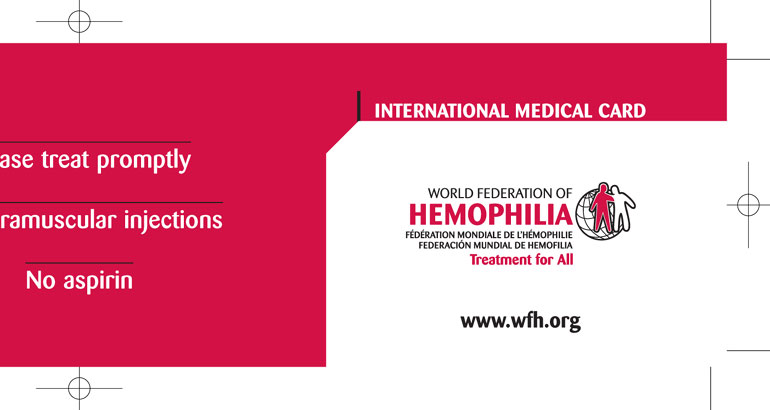
The World Federation of Hemophilia International Medical Card provides critical information to others in the case of an emergency.
A discussion of the mild forms of hemophilia A and hemophilia B, from epidemiology and molecular basis, via diagnosis, to
Acquired hemophilia is a rare condition caused by the production of autoantibodies, which inactivate factor VIII. This paper provides an