Hemophilia Societies: Challenges and Development
Outlines the common challenges faced by hemophilia societies at various stages of development and offers practical solutions to help these
Year: 2025
Language: English
Author(s): World Federation of Hemophilia
Format: Video
The global bleeding disorders community reached a major milestone in 2025, as the World Health Organization updated both its Essential Medicines List (EML) and Essential Medicines List for Children (EMLc) to align with modern international guidelines for hemophilia and von Willebrand disease. Led by the World Federation of Hemophilia (WFH), this achievement reflects two years of coordinated global advocacy, scientific collaboration, and direct engagement with the WHO. These updates will help improve equitable access to safer and more effective therapies for people with bleeding disorders worldwide.
In this video, watch a WFH expert panel discussion held in November 2025, where global stakeholders reflect on the significance of these landmark changes and what they mean for patients, clinicians, and health systems worldwide.
The panel is chaired by David Page, Consultant, Safety and Supply of Coagulation Products, Canadian Hemophilia Society and WFH Coagulation Product Safety, Supply and Access (CPSSA) Committee Member, includes the following speakers (in order of their seating in the video, left to right): Alain Baumann, CEO, WFH; Glenn Pierce, MD, PhD, WFH Vice President, Medical; Salome Mekhuzla, Director, Global Development, WFH; Radek Kaczmarek, Chair of the Coagulation Product Safety, Supply and Access (CPSSA) Committee, WFH; Mark W. Skinner, Board Member, WFH USA; Maria Elisa Mancuso, MD; Brian O’Mahony, Chief Executive, Irish Haemophilia Society; and Cesar Garrido, President, WFH.
The WFH does not engage in the practice of medicine and under no circumstances recommends particular treatment for specific individuals. For diagnosis or consultation on a specific medical problem, the WFH recommends that you contact your physician or local treatment centre. Before administering any products, the WFH urges patients to check dosages with a physician or hemophilia centre staff, and to consult the pharmaceutical company’s printed instructions.
The WFH does not promote any particular pharmaceutical product and any mention of any commercial brand in this presentation is strictly for educational purposes.

Outlines the common challenges faced by hemophilia societies at various stages of development and offers practical solutions to help these

This guide helps national hemophilia organizations plan and carry out an outreach campaign to identify people with hemophilia or other
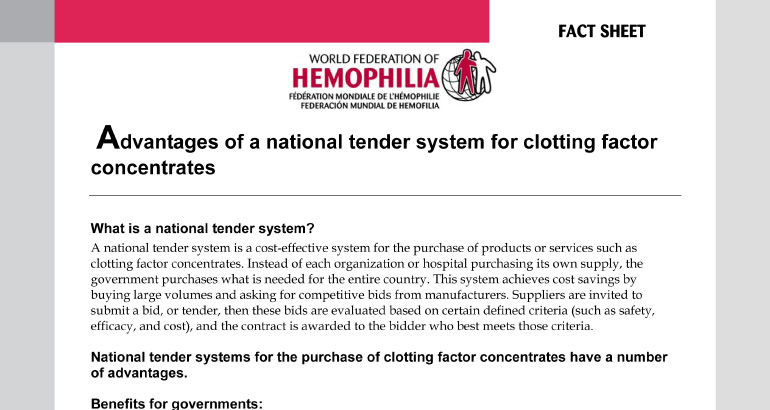
Also Available In: Japanese A national tender is a cost-effective system for the purchase of products or services, such as
Also Available In: Japanese Patient registries are crucial for monitoring trends in health, allocating resources, organizing and tracking distribution of
Also Available In: English, Spanish, French, Arabic, Russian, Simplified Chinese 患者登録は、健康上の傾向のモニタリング、資源の割り当て、治療用製剤供給の調整および追跡、全国規模での購入プロセスの改善に極めて重要です。
Having a national patient registry means being able to answer fundamental questions about the hemophilia population within a given country.