
General Care and Management of Hemophilia
This eLearning module presents Section 1 of the WFH Guidelines for the Management of Hemophilia: General Care and Management of

Year: 2016
Language: English
Author(s): WFH Laboratory Science Committee
Format: Video
This step-by-step video clearly demonstrates the correct technique for the execution of the manual assay for the presence FVIII inhibitors. Supplementing the Lab Manual written protocol (Section 28), it also explains the theory behind the assay, details the important reagents, discusses the challenges posed by limited resources, and works through the plotting and interpretation of a series of typical diagnostic cases including immediate acting and time-dependent inhibitors. The accompanying searchable transcript links to the individual sections of the video. A blank FVIII inhibitor assay record sheet and log-linear graph paper are also provided for free download.
Click on the player below to start the video, make sure that your computer speakers are turned on to hear the narration. Below the player is a searchable transcript. Enter a keyword in the search field to identify all the points in the script where it is mentioned. Click on the preceding section title to jump to that point in the video. A list of abbreviations can be found at the end of transcript. Click on the icons below to download the supplementary materials: FVIII inhibitor assay record sheet, log-linear graph paper, and Section 28 of the Lab Manual, Clotting Factor Inhibitor Screen Based on APTT.

This eLearning module presents Section 1 of the WFH Guidelines for the Management of Hemophilia: General Care and Management of

This eLearning module presents Section 5 of the WFH Guidelines for the Management of Hemophilia: Treatment of Specific Hemorrhages. Detailed

This eLearning module presents Section 3 of the WFH Guidelines for the Management of Hemophilia: Laboratory Diagnosis. Detailed illustrations, interactive
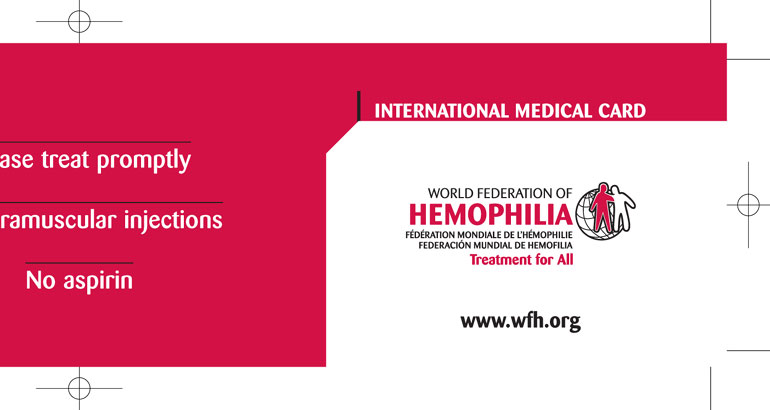
The World Federation of Hemophilia International Medical Card provides critical information to others in the case of an emergency.
A discussion of the mild forms of hemophilia A and hemophilia B, from epidemiology and molecular basis, via diagnosis, to
Acquired hemophilia is a rare condition caused by the production of autoantibodies, which inactivate factor VIII. This paper provides an